The French operator Société de Constructions Écologiques (SCE) joined the North-West Europe Interreg Circular Reno project in the second half of 2023.
The overall objective of the project, which brings together approximately 15–20 partners across Europe, is to develop agro-based and recycled or reused materials for building retrofit initiatives. The ambition is to implement four scalable bio-based deep energy retrofit packages for façade and roof systems, suitable for both collective and individual housing.
These solutions are intended to demonstrate how bio-based materials can support energy renovation while reducing the environmental footprint of construction.
SCE’s Role in the Project
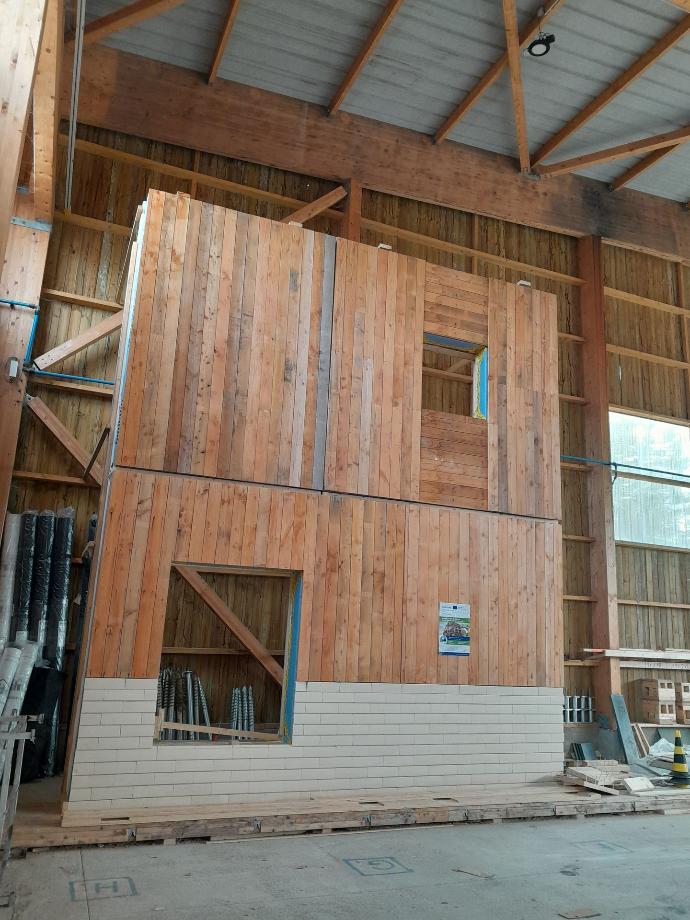
SCE has extensive experience in the design and prefabrication of 2D and 3D building elements using agro-based materials. Within the Circular Reno project, the company was responsible for developing façade prototypes suitable for collective housing, particularly for the French demonstration site operated by Vilogia.
The proposed solution is based on the external thermal insulation (ETI) concept, which improves building performance by insulating façades from the outside.
In order to minimise environmental impact, the solution relies primarily on bio-based materials such as wood and straw, which are recognised for their low embodied carbon and renewable origin.
Advantages of Prefabricated Bio-based Façades
Beyond providing a more environmentally friendly and healthier alternative to conventional insulation systems, this prefabricated approach offers several practical advantages.
Firstly, site disruption for residents is significantly reduced, since façade elements are manufactured off-site and installed quickly.
Secondly, the prefabrication process ensures greater control over production conditions, as manufacturing is independent of weather constraints that typically affect on-site construction activities.
Initial Technical Exploration
The first stage of SCE’s work consisted of identifying the technical requirements and exploring feasible solutions compliant with French building regulations for residential buildings.
To carry out this assessment, SCE collaborated with Neo-Eco, another French partner in the Circular Reno project specialising in environmental consultancy.
During this phase, several bio-based material options were evaluated and compared, taking into account:
- Technical performance
- Environmental impacts
- Market needs and feasibility
The French Demonstration Site in Tourcoing
The Vilogia pilot site, located in Tourcoing in Northern France, is a collective housing building constructed in 1956. The building contains 32 dwellings spread over three floors.
Vilogia aims to improve thermal comfort for residents by installing external façade insulation, making the building an ideal case study for testing innovative retrofit solutions developed within the project.
Development of the First Prototype
Following the technical study, SCE designed and manufactured a first façade prototype adapted to the specific characteristics of the Tourcoing building.
Subsequently, environmental assessments were conducted across the full life cycle of the prototype. The analysis considered several environmental indicators, including:
- Climate change (CO₂ emissions)
- Ozone depletion
- Fossil resource depletion
These results were then compared with conventional external thermal insulation systems, such as polystyrene and rock wool solutions.
Encouraging Environmental Findings
Some results from the study were particularly promising.
For instance, the contribution of raw materials during the supply phase showed a negative impact on climate change, due to the carbon captured and stored in the wood used in the system.
Additionally, the distribution stage showed a relatively low environmental impact, mainly because the system is intended to be produced and delivered locally to nearby construction sites.
Unexpected Carbon Footprint Results
Despite these positive aspects, the European partners were surprised by one key result.
The life-cycle analysis indicated that the carbon footprint of the bio-based façade prototype was 65% higher than the polystyrene system and 56% higher than the rock wool system in terms of CO₂ emissions.
Understanding the Methodological Bias
Further analysis revealed a significant methodological bias in the comparison.
The solutions were not directly comparable in their current form.
The bio-based façade developed by SCE is a heavy, self-supporting structure, which requires the construction of new concrete foundations. The carbon footprint associated with these infrastructures was included in the life-cycle assessment.
By contrast, conventional systems such as rock wool or polystyrene insulation are lightweight solutions, directly fixed to the existing façade without requiring additional foundations.
A Structural and Insulation Solution Combined
The real value of the SCE solution lies in its ability to address both insulation and structural reinforcement simultaneously.
This makes the system particularly relevant for buildings presenting structural weaknesses that require substantial renovation.
For buildings that are already structurally sound, such a solution may appear unnecessary. However, for degraded buildings requiring reinforcement, the SCE system becomes highly competitive as it integrates both structural strengthening and insulation in a single solution, something lightweight insulation systems cannot provide.
Development of a Second Prototype
Based on the lessons learned from the first prototype, and incorporating feedback from Circular Reno partners, SCE developed a second improved façade prototype.
One of the main modifications was to reduce the amount of straw used in the system, making the façade lighter.
In addition, the external facing was redesigned to better match the architectural identity of the Hauts-de-France region, improving the visual integration of the solution.
Improved Environmental Performance
Environmental assessments conducted on the second prototype confirmed the relevance of these improvements.
The results demonstrated that the redesigned façade generated 35% less CO₂-equivalent emissions than a conventional non-bio-based façade system.
These findings highlight the strong potential of optimised bio-based prefabricated façade systems for sustainable building renovation.