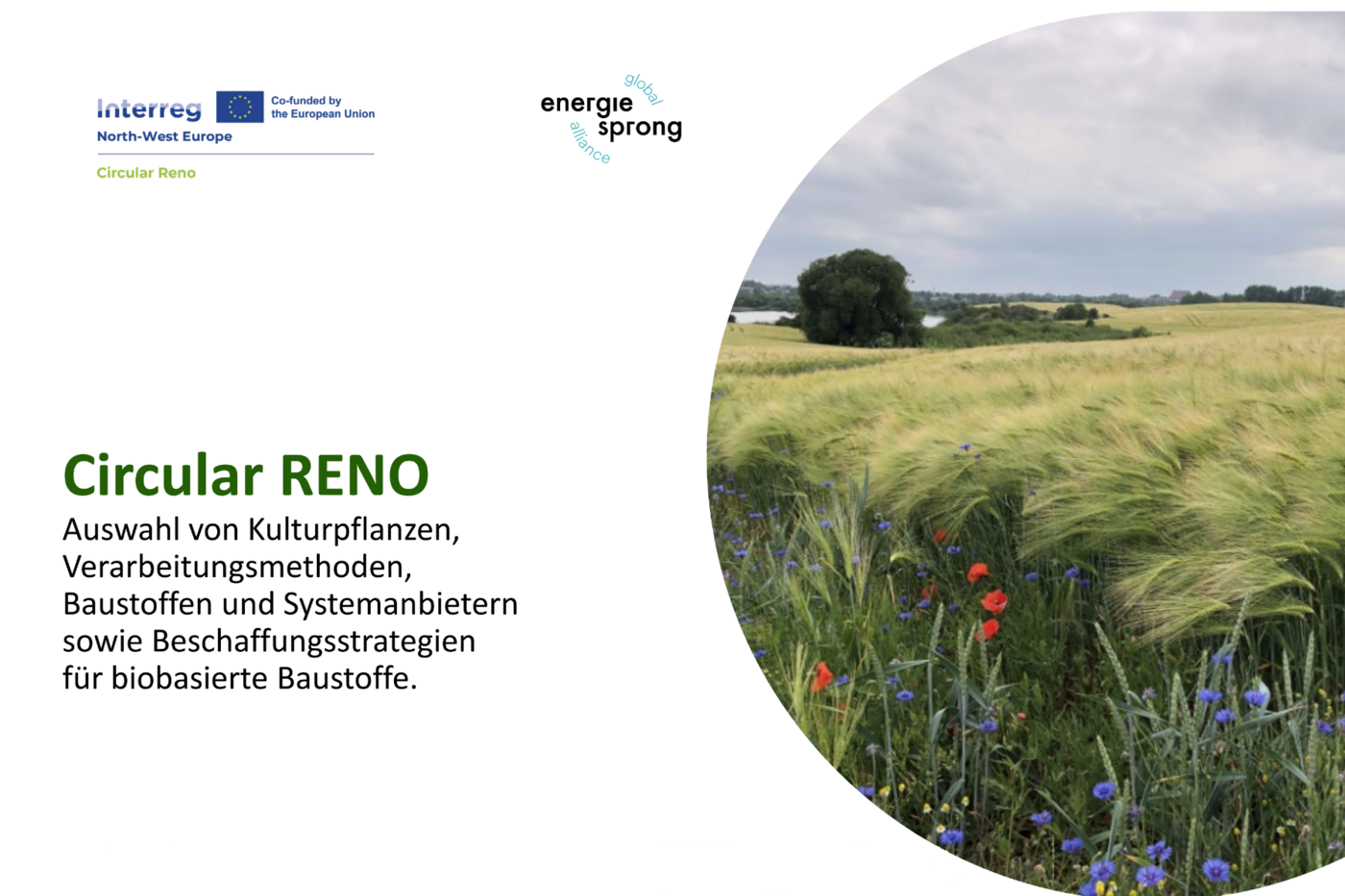
Developed within the EU project Circular Reno, the guide supports planners, suppliers, and construction stakeholders in the targeted selection, processing, and integration of bio-based building materials into prefabricated systems.
It provides an overview of plants such as miscanthus, hemp, flax, straw, and typha, information on their applications and processing technologies (from low-tech to high-tech), as well as practical examples and a directory of suppliers of prefabricated systems.
This guide provides information on:
- Overview of plants such as Miscanthus, hemp, flax, straw and Typha
- Evaluation of potential applications, advantages and disadvantages
- Classification of processing technologies (low- to high-tech)
- Practical examples and supplier overviews for pre-built systems
- Focus on regional value creation and short transport routes
- Supplementary annexes on building materials, circularity and ecosystem services
Discover the full guide in DE or EN
Additional resources :
- Ecosystem Services in DE or EN
- Circularity in DE or EN
- System Providers in DE or EN
- Overview Biobased Materials in DE or EN
Circular Reno guide to the selection of crops, processing methods, building materials and system suppliers, as well as procurement strategies for bio-based building materials
Bio-based building materials can become an integral part of climate-friendly and circular renovations – from insulation materials to prefabricated facade and roof systems. At the same time, many practical questions arise along the value chain: Which plants are suitable for which applications? Which materials and processing technologies are already available? What are the advantages and disadvantages of the different solutions? And which suppliers and system solutions are already on the market?
Circular Reno's new guide to plant selection supports planners, suppliers, manufacturers, craft businesses, housing industry, municipalities and private building owners in selecting bio-based materials and implementing climate-friendly renovation solutions with regional raw materials.
Developed as part of the EU project Circular Reno in cooperation with the University of Bonn/INRES, this guide offers clear guidance on selecting plant-based raw materials, processing methods, and bio-based products. The document, spanning nearly 90 pages, provides in-depth information on various plants, illustrates their potential applications, and assesses the advantages and disadvantages of bio-based building materials. Supplemented by an overview of the processing of bio-based insulation and building materials and a selection of existing prefabrication system providers, it offers practical support for implementation. The focus on local value chains is particularly valuable, as it shortens transport routes, reduces emissions, and strengthens the regional economy. Furthermore, the guide also highlights the ecosystem services provided by renewable building materials – such as biodiversity promotion, water retention, soil improvement, and carbon sequestration.
Plant-based raw materials in focus: From straw to typha
Whether miscanthus, hemp, flax, straw, or wet crops like typha – the guide presents various options with regard to site conditions, harvesting, maintenance, yield, and ecological impact. Economic aspects are also considered. For each plant, growing conditions, harvesting methods, processing steps, ecological benefits, and economic aspects are analysed – a practical decision-making aid for material selection.
Bio-based materials offer great opportunities for sustainable construction – but they are only effective if all stakeholders along the value chain are well-informed. Our guide creates transparency and demonstrates the possibilities that already exist for building with regional, renewable raw materials. This includes not only CO₂ storage in buildings, but also additional ecosystem services such as biodiversity promotion, water retention, and soil improvement. It provides a valuable foundation, especially for developing new partnerships between agriculture, processing, and the construction industry.
Petra van der Wielen, Senior Expert Innovation & Transformation, dena
From theory to practice: How to successfully use bio-based materials
Various prefabricated systems based on bio-based materials are already available for the serial renovation of facades and roofs. This guide provides an overview of currently available modular solutions – from straw bale and hemp insulation panels to miscanthus composite systems – and shows how these can be integrated into existing renovation processes. A list of suppliers with contact details and practical examples facilitates the selection process. Further practical appendices with direct implementation support include an overview of building materials and information on circularity and ecosystem services.
In addition, Circular Reno provides an interactive overview map of stakeholders along the bio-based value chain – from cultivation and production to processing and specialist trade, as well as associations, initiatives, training, and experts. The map helps to identify relevant market players, establish new collaborations, and strengthen regional networks.
To know more about this guide and related content, feel free to contact :
Petra van der Wielen
Deutsche Energie-Agentur GmbH (dena)
Senior expert Innovation & Transformation Climate-Neutral Buildings
petra.vanderwielen@dena.de